
Cellphone Policies That Work: Lessons for School Leaders


Few topics generate as much discussion in schools today as student cell phone use.
For many students, mobile phones are not simply devices. They are a primary means of communication, entertainment, information gathering, and social connection. For families, phones often provide peace of mind and a direct link to their children throughout the day. At the same time, educators increasingly see the challenges that unrestricted phone use can create in classrooms and across school campuses.
OBJECTIVES
- Build support for cell phone policies.
- Increase buy-in through communication and student voice.
- Support student focus and learning.
Research and experience continue to point to a common concern: when students are constantly connected to their devices, their attention, engagement, and learning can suffer. Even brief interruptions from notifications, messages, or social media can disrupt concentration and make it more difficult for students to fully participate in instruction. While mobile technology can support learning when used intentionally, unregulated use often creates barriers rather than opportunities.
A Growing National Conversation
There’s increasing evidence that the presence and usage of cell phone in the classroom—while not necessarily detrimental in all contexts—should be carefully monitored, intentionally structured, and even restricted in some cases.
–Edutopia
Across the country, states, districts, and schools are revisiting their approach to student cell phone use. What was once largely a school-level decision has become a broader conversation, as leaders grapple with concerns about distraction, student well-being, and the impact of constant connectivity on learning.
As new policies emerge, school leaders are finding that success depends on more than the rules themselves. Effective implementation requires clear communication, stakeholder engagement, and a shared understanding of why the change matters.
Several Oregon schools have approached this work thoughtfully, offering lessons for leaders navigating similar conversations in their own communities.
Start With the Why
One of the most important elements of any policy change is clearly communicating the rationale behind it.
When Milwaukie High School in Oregon revisited its approach to student cell phone use, then-Principal Carmen Gelman and her team understood that implementation would depend on more than simply creating a new rule. Success would require helping students, staff, and families understand why the change was necessary.
Watch Milwaukie Hight School’s cellphone PSA
Students, families, and staff are more likely to support a change when they understand the problem it is intended to solve. Rather than framing a cell phone policy as a disciplinary measure, Milwaukie High School focused on student success, engagement, and well-being. The message was not that phones were the problem. The message was that the school wanted to create conditions that allowed students to be fully present for learning.
This distinction matters. Research and educator experience increasingly suggest that the impact of cell phones extends beyond the moments when students are actively using them. As highlighted in Edutopia’s article, There’s a Cell Phone in Your Student’s Head, the mere presence of a phone can compete for students’ attention, making it more difficult to focus, retain information, and fully engage in learning. When leaders anchor conversations in student outcomes rather than compliance, they create opportunities for shared understanding rather than resistance.
Whenever possible, support the rationale with evidence. Whether drawing from school-level data, classroom observations, attendance trends, or broader research, concrete examples help stakeholders see that the policy is grounded in purpose rather than preference.
Just as important as communicating the rationale is giving people time to process change. Ideally, major shifts in expectations begin at the start of a school year. However, schools do not always have the luxury of waiting. When Milwaukie High School implemented changes during the school year, leaders intentionally announced the new expectations before spring break. The timing provided students, families, and staff with time away from school to process the information before implementation.
School leaders should consider not only what they communicate, but also when they communicate it. Building in time for questions, conversations, and reflection can significantly improve implementation. Families should be part of those conversations from the beginning. Clear communication with families can help reduce confusion, build trust, and create consistency between home and school expectations.
Throughout the rollout, students heard a consistent message: “We care about you.” School leaders acknowledged that the decision was difficult and recognized that adults often struggle with managing their own device use as well. By taking ownership and framing the policy as a shared responsibility, leaders avoided creating an “us versus them” dynamic.
The goal was never control. The goal was creating an environment where students could be safe, supported, engaged, and successful.
Build a Policy People Can Follow
Even the most thoughtful policy will struggle if expectations are unclear.
Students should know exactly when phone use is permitted, when it is not, and how exceptions are handled. Staff members should have a shared understanding of procedures and consequences so implementation remains consistent across classrooms.
Milwaukie High School’s policy communicated both expectations and consequences clearly. Students understood when phones could be used, when they needed to be put away, and what would happen if expectations were not met. The policy also allowed room for mistakes and reminders before more significant consequences occurred.
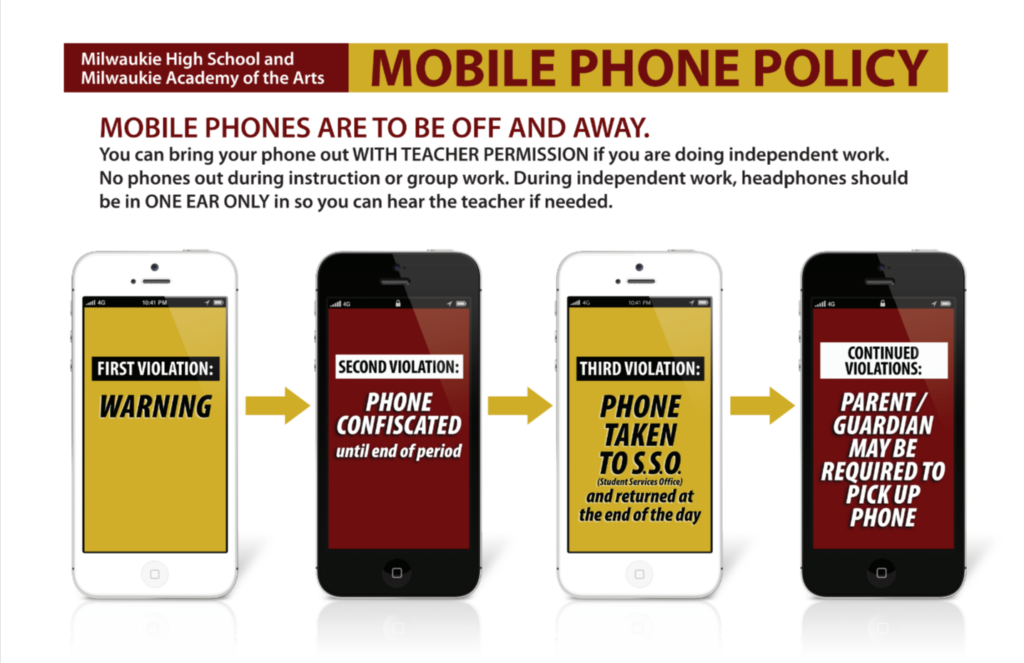
Clarity reduces confusion, increases fairness, and helps staff respond confidently when issues arise.
Perhaps the most significant lesson from Milwaukie High School’s experience is that effective implementation requires collective commitment.
Students quickly recognize inconsistencies. If expectations vary dramatically from classroom to classroom, the policy becomes difficult to enforce and easy to challenge.
A successful approach requires alignment among administrators, teachers, support staff, and, when possible, families. When everyone communicates the same expectations and reinforces the same message, students experience the policy as a schoolwide commitment rather than an individual teacher preference.
Student voice can also play a critical role in successful implementation. When Oregon introduced a bell-to-bell cell phone ban, Amanda Bagwell, Vice Principal at Sherman County School District, knew the rollout needed to be handled thoughtfully. Students felt unsettled, families had strong concerns, and teachers worried about how they would manage the new expectations. After working with administrators and teacher leaders to develop a plan, Bagwell realized an important perspective was still missing: students.
When the school engaged its student leadership team, students acknowledged the potential benefits of the policy while also identifying a practical need. If phones were no longer available during lunch and breaks, students wanted other ways to connect and engage. In response, the school expanded opportunities such as opening the weight room and providing board games and other activities that reflected a range of student interests. The rollout was remarkably smooth, offering a clear reminder that students are often key partners in creating solutions that work.
Ultimately, successful implementation depends on creating a sense that everyone is working toward the same goal. The message becomes simple: we are all in this together.
Measure, Adjust, and Grow
Implementing a policy is only the beginning. Understanding whether it is making a difference is equally important.
School leaders should consider establishing systems to track policy violations and compare trends with other indicators such as attendance, engagement, behavior referrals, and academic performance. Over time, this data can help schools evaluate effectiveness, identify patterns, and determine whether adjustments are needed.
Transparency is also critical. When the policy is producing positive results, celebrate those successes with the school community. When challenges emerge, share them honestly and invite stakeholders into the problem-solving process.
The most effective policies are not static. They evolve as schools learn what works best for their students.
Although discussions about cell phone use often focus on middle and high schools, elementary schools face many of the same challenges. The principles remain largely the same: communicate the purpose, establish clear expectations, involve families, and implement consistently. What changes is the approach. Younger students may benefit from a practice period before consequences take effect, and family communication often plays a larger role in successful implementation.
As schools consider device use at younger grade levels, many are also engaging in broader conversations about how technology supports learning and development. Regardless of grade level, the goal remains the same: creating learning environments where students can focus, engage, and thrive.
Moving Forward
Cell phone policies will likely remain a topic of debate for years to come. There is no universal solution that works for every school community.
However, the experiences of Milwaukie High School and Sherman County School District demonstrate that successful implementation depends less on the specific rules and more on how those rules are introduced, communicated, and supported. When leaders ground decisions in student success, communicate with empathy, and create shared ownership across the school community, even challenging policy changes can become opportunities to strengthen school culture.
The conversation is not ultimately about phones. It is about creating the conditions that allow every student to be fully present for learning.










Responses